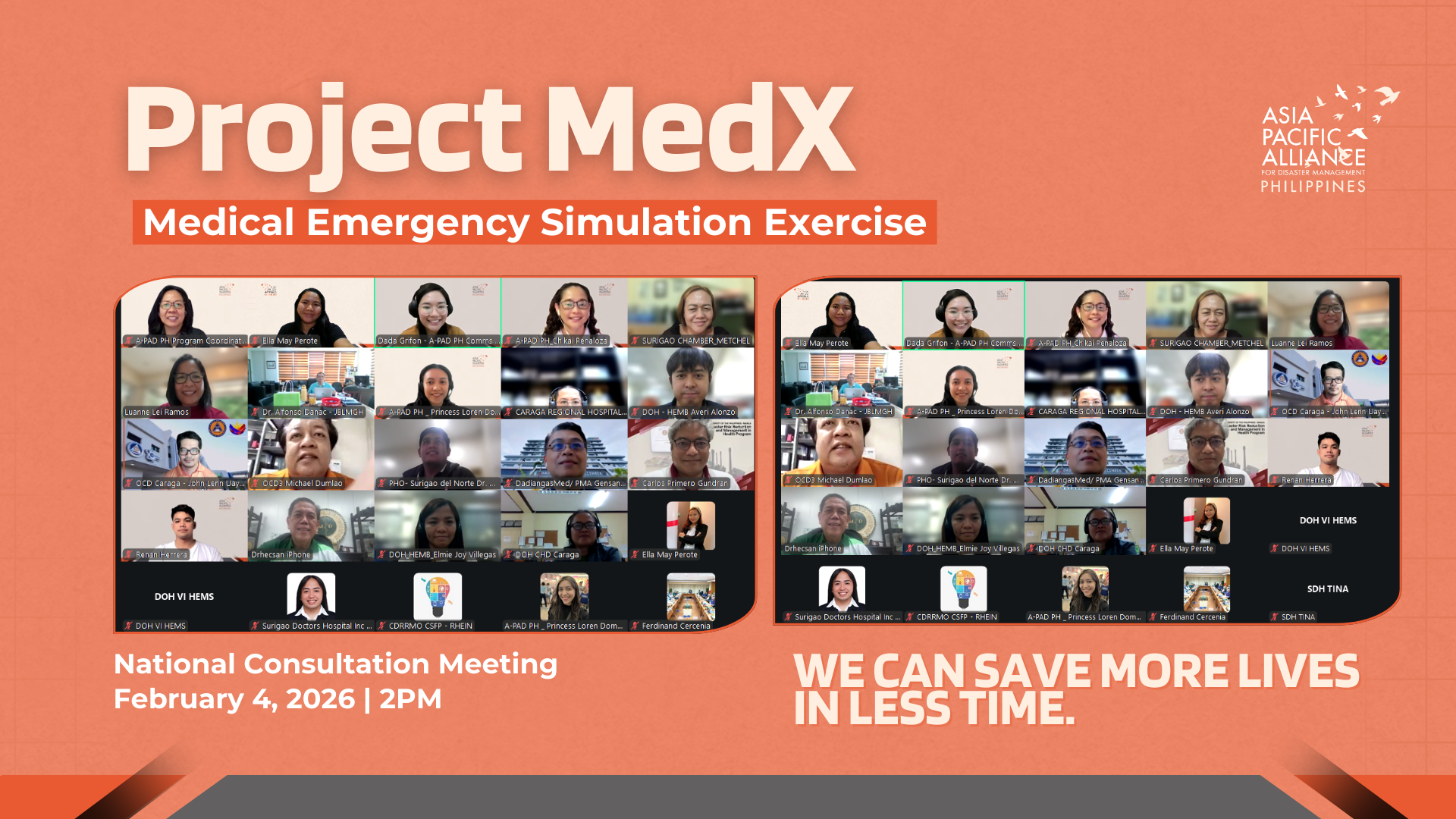
The Asia Pacific Alliance for Disaster Management (A-PAD) Philippines has officially launched Project MedX: Medical Emergency Simulation Exercise, its flagship medical disaster preparedness initiative designed to strengthen the country’s emergency medical response systems through coordinated, multi-sectoral action.
The initiative was formally introduced on February 4, 2026, through an online National Consultation Meeting that convened a diverse group of stakeholders from the health and disaster risk reduction sectors.
Participants joined from Central Luzon, Caraga, Western Visayas, and various national offices, reflecting strong multi-level engagement and cross-sector collaboration.
Representatives in attendance included the Philippine Medical Association (PMA), Office of Civil Defense (OCD) Regions III, VI, and CARAGA, Department of Health – Health Emergency Management Bureau (DOH-HEMB), DOH Center for Health Development Western Visayas and CARAGA, Jose B. Lingad Memorial General Hospital (JBLMGH), University of the Philippines Manila – Disaster Risk Reduction and Management in Health (UP Manila DRRM-H), Dadiangas Medical Center/ PMA General Santos Chapter, Surigao Provincial Health Office, Surigao Doctors Hospital, Surigao Chamber of Commerce and Industry (SCCI), One Network PH, and the City of San Fernando DRRM Office.
In her opening remarks, Athea Peñaloza, A-PAD PH Executive Director underscored that Project MedX was born from years of collaborative medical emergency preparations.
“We’ve been doing several medically related emergency preparations — from basic emergency care training to the tripartite medical simulation exercise we conducted in Central Luzon with our partners. Drawing from that experience, we now want to roll it out to other regions and localities,” Peñaloza said.
In a country frequently battered by typhoons, earthquakes, and other hazards, disasters often overwhelm emergency medical systems. Challenges such as limited surge capacity, coordination gaps, uneven resource distribution, and insufficiently trained personnel continue to strain response mechanisms.
Project MedX seeks to bridge these gaps by uniting medical professionals, responders, government agencies, private partners, and communities under a coordinated framework for simulation-based preparedness.
By institutionalizing regular, well-designed medical emergency exercises, the program aims to enhance readiness before the next disaster strikes.
Many of the partners who attended the consultation were instrumental in the inter-agency collaboration that paved the way for the first-ever private sector-led tripartite medical simulation drill in April 2025.
“This is not A-PAD alone. The simulation we did last year would not have been successful without the collaboration of different agencies. We want to replicate that in other localities,” Peñaloza added.
To provide a broader perspective on the exercise, Dr. Charlie Gundran, UP Manila DRRM-H Head and UPRI Division Director presented key lessons and takeaways from last year’s drill, highlighting both operational strengths and areas for improvement.
He also shared insights from a similar large-scale exercise in Japan, emphasizing the importance of setting clear objectives, ensuring proper planning, and preparing comprehensive logistical support.
Medical Community Signals Support
Participants expressed strong interest in collaborating and raised critical questions on the scope of simulations, funding mechanisms, and the delineation of roles among stakeholders.
“There will be no objections since there are multiple things that we need to test, but we just need to prepare exactly what we want to test. We may want to conduct the same simulation as last year but this time, we must be clear which specific areas of that exercise we want to review or assess,” Dr. Alfonso Danac, JBLMGH Chief of Medical Professional Staff II said during the open forum.
Likewise, Dr. Hector Santos, PMA President, expressed readiness to collaborate closely with A-PAD PH in advancing emergency preparedness efforts.
“In many emergency responses, our doctors are already there, responding when called upon. We are willing to do the same with all the responses that A-PAD PH plans to undertake in preparation,” Santos said.
Meanwhile, Dr. Rey Ponteras, Chairman of the Emergency Department- Dadiangas Medical Center and Committee Head on PMA Disaster and Emergency Response in General Santos City welcomed the initiative as both timely and aligned with its upcoming disaster risk reduction planning activities.
“We see this as an opportunity to integrate it into our standard operating procedures and strengthen our incident management systems,” Ponteras said.
Over the next few months, A-PAD Philippines will conduct more detailed planning sessions in selected areas to refine implementation strategies and localize the approach.
More than a single program, Project MedX represents a long-term commitment to strengthening health emergency systems nationwide.
As A-PAD Philippines scales the initiative across the country, it calls on partners to stand united in ensuring that communities, institutions, and responders are equipped to face disasters with resilience, coordination, and effective communication.