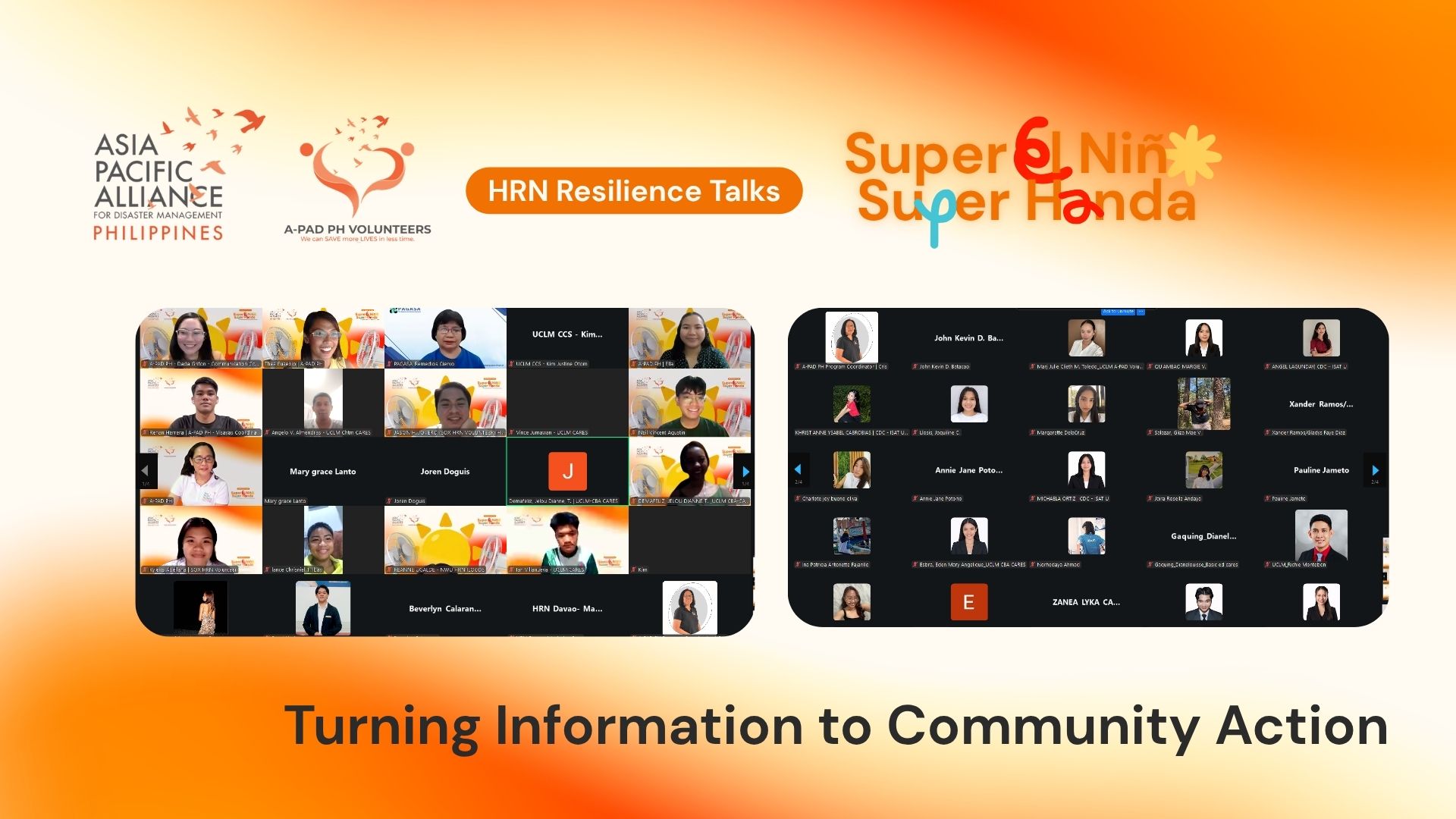
Youth leaders, student organizations, and humanitarian volunteers from across the Philippines gathered online on October 15 for the A-PAD Philippines Human Resource Network (HRN) Resilience Talk, launching a network-led information campaign to strengthen community preparedness for El Niño.
The session introduced “Super El Niño, Super Handa | Turning Information into Community Action,” an initiative that aims to translate climate risk information into practical preparedness measures and community-led action.
In her opening remarks, A-PAD Philippines Executive Director Athea Peñaloza emphasized the role of young volunteers in making information accessible and encouraging communities to prepare.
“We can be important information sharers, community listeners who understand the situations in our communities, and storytellers who make information easier for others to understand. More importantly, we are mobilizers who can encourage families and community members to take action,” Peñaloza said.
She clarified that being “Super Handa” does not mean stopping El Niño, but preparing for its effects and working together to reduce its impact.
In September, the Philippine Atmospheric, Geophysical and Astronomical Services Administration (DOST-PAGASA) forecast that El Niño conditions could intensify through the first half of 2027. The phenomenon may bring higher temperatures and prolonged dry spells, with potential impacts on public health, livelihoods, food security, and water access.
PAGASA Senior Weather Specialist Engr. Remedios Ciervo provided a situation briefing on El Niño, discussing its potential impacts and the importance of early preparedness.
“We should not be afraid to the point that we panic. Not all areas will be affected in the same way. What is important is that we prepare early, even through small actions, such as conserving water. We also have regular coordination meetings where PAGASA provides forecasts that help agencies plan and make informed decisions,” Ciervo said.
Through the HRN Volunteers, participants are encouraged to become information multipliers, community listeners, storytellers, and mobilizers who can share verified advisories, promote practical preparedness measures, and document local experiences and adaptation practices.
The discussion also highlighted how individual actions can contribute to collective preparedness. Reanne Ugalde, an HRN volunteer from Northwestern University in Ilocos, encouraged fellow young people to recognize that even small efforts can make a difference.
“As students, we sometimes think that what we can do is limited. But I believe we can still contribute in simple ways, such as conserving water, avoiding waste, taking care of our health, and sharing reliable information with our families and communities. Even simple actions, when we do them together, can make a real difference,” Ugalde said.
Coming from a community that has experienced similar conditions in Cagayan, Ugalde said the discussion was particularly meaningful to her. She expressed hope that volunteers would continue working together to raise awareness and build safer, better-informed, and more prepared communities.
At the end of the session, participants brainstormed ideas for multimedia content and community activities to support the campaign. Their contributions will help shape how volunteers communicate El Niño risks, engage their networks, and encourage practical action at home, in schools, organizations, and communities.
The information campaign will be rolled out through A-PAD Philippines’ official website and social media pages, featuring content ideas and community-driven initiatives developed by youth volunteers during the workshop.
As El Niño conditions develop, the campaign calls on young people and communities to turn information into action and help build a more prepared and informed Philippines.